
Round 2:
An app designed to help households and businesses reduce food waste
You can either watch this case study in video format or scroll down to read it. The reading will take approximately 30 minutes.
Note: This project is a course requirement for a current Product Management with UXUI course I am taking with Mages Institute. We were tasked with designing a sustainability-themed mobile app to address sustainability issues. I chose to tackle food waste, read on to find out how and what I did!
.jpg)

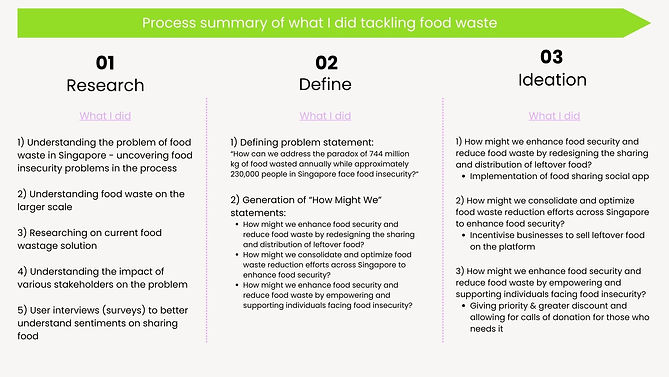
PROBLEM
In 2019, Singapore wasted an astonishing 744 million kilograms of food, while approximately 4.1% of Singaporeans—around 230,000 individuals—experienced moderate to severe food insecurity. This means they faced hunger and struggled to obtain adequate food, often compromising on quality and quantity. It’s ironic that such a significant amount of food is wasted in a country renowned for its wealth, home to many millionaires, and recognized as one of the most expensive cities to live in. Yet, a considerable portion of its population still grapples with hunger.
THINKING AT A SYSTEMS LEVEL
Food waste is a major issue with far-reaching consequences that extend beyond just uneaten food. The problem is interconnected with various other aspects of the food system, and failing to look at the bigger picture means we miss opportunities to solve it effectively. A problem never exists in isolation—it's part of a broader system. To make it easier to digest, I’ve summarized the key points in the infographic below, so feel free to skip the more detailed explanation that follows.
Key Drivers of Food Waste:
-
Overproduction: Farmers and producers often grow more food than necessary, anticipating losses due to market demands, unpredictable weather, or pests.
-
Distribution Challenges: Poor infrastructure, inadequate storage, and inefficient supply chains lead to substantial food loss before products even reach consumers.
-
Market Waste: Supermarkets and retailers frequently discard food that doesn’t meet aesthetic standards or is close to its sell-by date, even if it’s still safe to eat.
-
Consumer and Commercial Waste:
-
Households: Overbuying, improper storage, and misinterpretation of expiration dates cause significant waste. Lack of meal planning and cooking in excess also contribute.
-
Restaurants and Catering: Preparing food in large quantities to meet uncertain demand leads to significant waste, especially in buffets and large events.
-
-
Cooked Food Waste in the Hospitality Industry:
-
Hotels and Buffets: In the pursuit of variety and abundance, large amounts of food are prepared and often wasted.
-
Catering and Events: Overestimating guest numbers or preparing “just in case” results in significant amounts of uneaten cooked food.
-
-
Environmental Impact: When food waste, particularly cooked food, ends up in landfills, it decomposes anaerobically, releasing methane—a potent greenhouse gas. Cooked food waste is especially harmful, as it represents the loss of additional resources like energy and water used in its preparation.
-
Economic Loss: The resources used to grow, distribute, and cook wasted food represent a significant economic loss for farmers, businesses, and consumers alike.
-
Social Consequences: Despite food abundance, inefficiencies and wastage contribute to food insecurity. The resources lost in wasted food could be redirected to address hunger and food access issues.
-
Policy and Regulatory Gaps: A lack of effective policies around food production, distribution, preparation, and waste disposal perpetuates the problem, making it harder to break the cycle.
Understanding these interconnected drivers of food waste is crucial for developing more effective solutions. However, for this case study, my focus is on reducing consumer and commercial food waste, where significant opportunities for impact exist.

UNDERSTANDING THE PROBLEM
Having defined the problem, my next step is to conduct comprehensive research to gain a deeper understanding of food waste and how we can effectively address it. My primary objectives are to explore existing solutions, identify gaps in those solutions, and assess user sentiments regarding current technologies and their associated pain points.
To guide my research, I thought about:
-
What solutions are currently in place to tackle food waste?
-
What gaps remain in these solutions?
-
What are the experiences and sentiments of users who have adopted available technologies?
-
What challenges do they face in implementing these solutions?
By addressing these questions, I can ensure that my approach is informed and relevant. In general, the key strategies listed below can be used to tackle food waste,
-
Portion Control: Restaurants and caterers can offer smaller portions, allowing customers to request additional servings if needed.
-
Leftover Management: Encouraging consumers to creatively use leftovers and providing effective storage tips can significantly reduce household waste.
-
Food Donation: Facilitating the donation of surplus cooked food from restaurants and events to those in need is essential.
-
Education and Awareness: Launching campaigns to educate consumers and businesses about the impacts of food waste and strategies for minimizing it is crucial.
-
Innovative Technologies: Developing and adopting technologies for better food preservation and efficient waste management can play a significant role.
-
Regulations and Incentives: Implementing supportive policies and incentives to reduce food waste in the hospitality industry, including measures to encourage food donation.
but let's not jump to conclusions—let's do our research first!
Current solutions in place
To ensure we arrive at the best solution, we must examine existing methods to identify where they fall short. While many current solutions address food waste, we should focus on practical, straightforward approaches that effectively meet the needs of those involved. By understanding these gaps and refining our approach, we can create a solution that is both accessible and impactful
1
2
.jpg)
3
4
.jpg)
The current efforts combating food waste can be generally summarized as:
1. Reselling surplus food at a lower price
-
This initiative involves businesses, such as supermarkets and restaurants, selling food items that are nearing their expiration date or are in excess supply at reduced prices.
-
By providing consumers with lower-cost options, this approach not only helps reduce waste but also makes food more accessible to those on a budget
2. Selling ‘ugly’ produce at a lower price
-
This effort targets fruits and vegetables that may not meet aesthetic standards for retail, often referred to as "ugly" produce. Instead of being discarded, these items are sold at a discount.
-
This approach not only reduces food waste but also challenges consumer perceptions about food quality, promoting the idea that all produce, regardless of appearance, is nutritious and valuable.
3. Giving away free food
-
Various organizations, including food banks and community groups, distribute surplus food for free to individuals and families in need. This approach ensures that edible food is not wasted and helps address food insecurity.
-
By redistributing food to those who may not otherwise have access, these initiatives tackle both food waste and hunger in the community.
Overall, these efforts demonstrate an increasing awareness of the food waste crisis and a dedication to finding innovative solutions. However, there are several challenges in the current approaches to combating food waste, which I have identified as follows:
1. Lack of consolidation across F&B establishments in Singapore, leading to fragmented efforts.
2. Reliance on users actively searching for bargains, creating friction in the user experience and potentially resulting in lower adoption rates.
3. The 'first come, first serve' distribution model may prevent food-insecure individuals from accessing affordable food.
Understanding the impact stakeholders have on the issue
With an understanding of current initiatives, we now move on to stakeholder mapping to identify how we can better target our solution for greater effectiveness. In addressing food waste, the government, non-profit organizations, and businesses all play crucial roles in reducing it. However, it’s important to remember that even small actions—like consuming just a bit more—can help reduce waste. Everyone can play a role in this effort.
Through stakeholder mapping, we can identify those with the greatest influence—both supportive and opposing—and develop strategies to manage these relationships, ensuring a more comprehensive approach to tackling food waste.
.jpg)
.jpg)

How might we tip this balance such that food insecure and everyday Singaporeans can play a bigger role in helping to reduce food waste? Afterall one more bite from everyone equals less wastage
User interviews
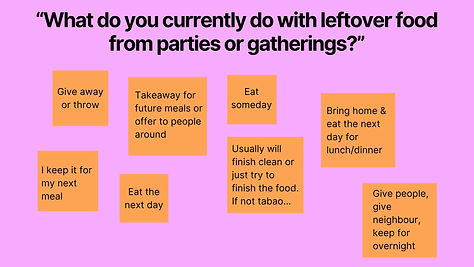
Before diving into ideation and solution development, I conducted user interviews to gain deeper insights into the sentiments surrounding food waste. My primary goal was to understand people's attitudes toward receiving leftovers, allowing me to frame the solution in a way that addresses their concerns and reservations.
Since various initiatives already exist, I aimed to assess their effectiveness and relevance. To achieve this, I approached 8 to 10 individuals with the following questions, gathering valuable responses that will inform the development of my solution.
I derived insights from the responses using the 'Roses, Thorns, Buds' exercise. This method allows me to identify positive aspects (Roses), challenges or issues (Thorns), and opportunities for growth or new ideas (Buds) within the feedback I received. By employing this approach, I can better understand the sentiments surrounding food waste and develop a more effective solution.
Now that we have a clearer understanding of the problem, we can begin to narrow our focus to specific areas for development.
.jpg)
.jpg)
.jpg)
.jpg)
.jpg)
.jpg)
In conclusion, the insights I gather from all the research are:
1) People are willing to share leftovers but it has to look presentable & is safe
2) People do their best to not waste food
3) Despite efforts available to reduce food waste, people are still unaware of it
IDENTIFYING KEY AREAS OF FOCUS
In response to the identified problem and the research findings, I have refined my focus to the following 'How Might We' statements. My approach to defining the problem involves asking 'why' repeatedly until a viable solution emerges.
-
How might we enhance food security and reduce food waste by redesigning the sharing and distribution of leftover food?
Since sharing food is inherently a social experience, I considered ways to reframe and redesign the food-sharing process. My research indicates that while people are generally open to sharing food, there is often a stigma associated with sharing food, especially if they weren't present at the original event. For example, in my company, employees typically wait until events conclude before approaching the catered food for leftovers. However, would they exhibit the same behavior if the source of the food is perceived as questionable? This suggests that the willingness to share food is influenced by the food's source.
-
How might we consolidate and optimize food waste reduction efforts across Singapore to enhance food security?
What incentives could encourage businesses to participate in food waste reduction initiatives? Currently, many efforts seem limited to restaurants and hotel buffets. Why not extend these initiatives to all businesses that serve food and beverages to the public? Identifying strategies to broaden participation could be key to enhancing the overall impact.
-
How might we empower and support individuals facing food insecurity to enhance food security and reduce food waste?
What measures can we implement to simplify the support needed for those experiencing food insecurity? Could there be a centralized platform that allows individuals to easily find affordable food options? Additionally, how might we prioritize their access to discounted food items?
By addressing these 'How Might We' statements, I hope to achieve innovative solutions that effectively tackle food waste and enhance food security.
So, what innovative solutions have I developed?

SOLUTION
The brief specified the development of a mobile application as the solution, which I focused on. After several iterations, I refined my ideas to arrive at this final version.
I also dedicated time to selecting the appropriate tone and fonts for the application. Since the app aims to encourage food sharing, I opted for a cream and red color palette to symbolize passion and promote a spirit of giving.
My mid-fidelity prototype is presented as follows:
USER FEEDBACK

I used the lo-fi prototype to explain the app to my friends and gather their feedback. My insights and updates are highlighted in blue.
Feedback #1: Elderlies are more likely to fall under the food insecure group might not have access to the app or might have a hard time using it because they are not tech savvy. Other people who are food insecure might also not have access to smartphones
-
Registration can be facilitated at Community Centres or Resident Centres, or individuals can be linked to a social worker or any existing support services they are currently receiving.
Feedback #2: Worried about the adoption rate because food at hawker can be affordable as well, why would they want to camp at the app for minimal savings?
-
On a national level, the government needs to enhance initiatives aimed at reducing food waste: collaborate to lower prices, increase awareness about waste reduction, and implement stronger strategies. For instance, in the F&B industry, surplus food could be sold at reduced prices through an app, rather than being discarded.
-
I'm also concerned whether the current app design gives people the impression that it's just another food delivery app. I need to conduct more research to accurately determine this, as it's currently just a guesstimation.
Feedback #3: The app can features location tagging, ensuring users can view food businesses near their current location. This makes logistics simple and convenient, allowing for easy access to nearby food options and reducing the hassle of transportation.
-
The app now includes a location feature that automatically tags users' current locations while also allowing them to select any preferred location for convenience.


REFLECTIONS
Key learnings
-
I explored a wide range of topics but found that my research lacked depth. I now realize that conducting more thorough investigations could have provided deeper insights from users. While my solutions are primarily theoretical, I could have delved further into how they could be addressed through better design.
-
This experience has made me recognize that UX design is a form of visual communication. Effectively conveying ideas is an art that takes time to master. I've begun to appreciate the more philosophical aspects of UX design and see significant opportunities for improvement.
-
I also want to enhance my design thinking skills to navigate the design process more effectively. I struggled to untangle the complexities of this problem, and I realize that presenting my work as a polished case study doesn't fully reflect the journey I've undertaken.
-
I genuinely enjoy delving into problems, but I've noticed that I tend to get lost in research, driven by my desire for comprehensive solutions. Additionally, I could have benefited from hands-on experience with the app to uncover user pain points more effectively."
Moving forward
-
I would like to focus on redesigning the application and explore ways to conduct more in-depth user research. My goal is to derive better insights, emphasizing user experience over market research.
-
I would like to focus on enhancing my ability to translate ideas into effective design.


Thanks for reading! Feel free to drop me a comment


Your portal back home
or view my other works!

A personalized recipe app tailored to your schedule and available ingredients

A personalized recipe app tailored to your schedule and available ingredients