
Enhancing the FairPrice App Experience
You can either watch this case study in video format or scroll down to read it. The reading will take approximately 30 - 40 minutes.
Note: This project is a course requirement for a current Product Management with UXUI course I am taking with Mages Institute. We were tasked to enhance the FairPrice App experience.


In this project, my design process is summarized in the diagram below. I learned to approach UX differently; while the first project with Mages Institute focused on creation and development, this process is tailored for enhancing and improving the app
.jpg)
INSIGHTS INTO INDEPENDENT LIVING: FINDINGS FROM RESEARCH
As part of our project to enhance the FairPrice app experience, we were tasked with identifying a target demographic. I chose to focus on young adults (ages 18–35) living independently in Singapore, aiming to tailor the app to better meet their unique needs and shopping behaviors.
To start off this project, I want to gain insights into living independently before embarking on my customer journey mapping. Understanding the unique challenges faced by young adults in this context is essential for developing effective solutions. I believe that conducting general research is a valuable way to kick off the UX project, as it provides a foundational understanding of the kinds of problems individuals face. This groundwork enables informed decision-making and helps identify the core issues that need to be addressed. By understanding the background, I can formulate thoughtful questions for potential interviewees, enabling me to delve deeper into their challenges.
Here’s a summary of my findings:
#1: Expensive Rent in Singapore
This may affect the quality of life in other aspects at the expense of freedom.
#2: Weight Gain Due to Stressors
Approximately 60% of Singaporeans gain weight in the first eight years after starting their careers, with many preferring to mitigate stress and fatigue through food or sleep.
#3: Food and Cost Wastage:
A lack of familiarity with cooking and grocery shopping leads to significant waste. For example, Mr. Zainuddin spent $300 on just four weekly supermarket trips in his first month.
#4: Healthier Home-Cooked Meals:
Singapore’s highly accessible food environment makes it easy to eat out, with 77.3% of residents having at least one meal outside the home. However, commercially prepared food is often less healthy than home-cooked options.
These insights highlight the challenges faced by young adults living independently in Singapore, particularly around managing their food choices and overall well-being. Understanding these pain points is essential for creating an effective customer journey map, as it allows us to visualize the specific experiences and emotions that users encounter during their grocery shopping and meal preparation. By mapping this journey, we can identify critical touchpoints and areas for improvement that directly address the issues uncovered in my research.
CUSTOMER JOURNEY MAPPING
I conducted an in-depth customer journey mapping through my eyes, using contextual inquiry and research to capture authentic user experiences. By observing users in their natural environments and asking targeted questions, I uncovered key pain points and motivations at each stage of their journey, leading to actionable design recommendations that directly addressed users' needs.

PAIN POINTS
From my research and customer journey mapping, I identified key insights that highlight their challenges and decision-making processes. These insights reflect the common hurdles faced by individuals as they engage with food selection and preparation:
#1: “Which apple should I choose, and how long will it last? How many should I buy?”
Problems in choosing food produce - Many individuals are unsure about which fruits and vegetables are fresh and how to properly store them, leading to confusion in their grocery choices.
#2: “This raw chicken breast is just meat to me, but to my mother, it’s sesame chicken today, curry chicken tomorrow. What can I cook?”
Problems in recipe generation - A lack of familiarity with recipes increases stress, making it challenging for individuals to transform basic ingredients into meals.
#3: “There are 5 different brands of peanut butter! Which one should I pick?”
Problems in navigating options - Beginners in grocery shopping often struggle to establish personal taste preferences and may adapt their choices based on their cooking skills and habits.
HEARING DIRECTLY FROM THOSE LIVING INDEPENDENTLY
Conducting general research and deriving insights from customer journey mapping is only the starting point. After gaining a clearer understanding of the context, I transitioned into user research. I initiated this phase with user surveys to gather feedback from the targeted demographic, aiming to deepen my insights and refine my approach. I asked questions such as [insert specific questions] to gain a more nuanced understanding of their needs and preferences.
Here are some of their insights:
.jpg)
PERSONA CREATION
Creating personas is a vital part of the UX design process, and my workflow began with comprehensive research, including user interviews and surveys, to collect both qualitative and quantitative data. After analyzing this data, I identified common patterns and segmented users based on shared characteristics such as demographics and behaviors. I started with an empathy map to capture users’ feelings and motivations, which then informed the development of a detailed persona.
.jpg)
.jpg)
KEY CONSIDERATIONS FOR ENHANCING THE FAIRPRICE EXPERIENCE
I’ve explored the challenges of independent living, particularly in terms of self-sufficiency with food which leads me to ask: How might we empower these young adults to live independently with the support of FairPrice?
I’ve broken this down into the following 'How Might We' questions:
-
HMW allow users/customers to identify the best fruits to pick? Is there a way to tell how long the fruits can last?
-
HMW enable users/customers as a beginner on their cooking journey?
-
HMW simplify the grocery buying experience?
-
HMW enable users/customers make the best choice while grocery shopping?
-
HMW help users/customers plan their meals better & help reduce food waste?
-
HMW help users easily choose the best option from a variety of choices?
I’m reminded of the first UX/UI case study I completed, which inspired me to integrate those concepts here, as it seems relevant.
ASSESSING THE BUSINESS OBJECTIVES OF FAIRPRICE
To effectively enhance the FairPrice app, it’s essential to understand FairPrice’s business objectives and core values. This ensures our improvements are aligned with the company’s vision. This is what I gather from their website:
In summary, I understand that FairPrice aims to achieve the following goals. Before proceeding with the enhancements to my application, I will consider whether these improvements align with their objectives outlined below:
With a clearer understanding of FairPrice’s values and the goals they aim to achieve with the app, I proceeded to analyze the application to identify additional areas for improvement.
Established in 2019, FairPrice Group comprises four main social enterprises - NTUC FairPrice, NTUC Foodfare, Kopitiam, and NTUC Link. With the vision of being a leader in everything food, our purpose as a social retailer is to make life better for all. Delivering personalised and delightful experiences With an extensive network of over 570 touchpoints, FairPrice Group seeks to provide an integrated array of products and services. From groceries, ready-to-cook and ready-to-eat offerings, to on-premise meals, food take-aways, and a rewards programme, we’re making food personal for everyone. With an appetite for excellence, we optimise the resources of all four social enterprises, leveraging their respective strengths to be Customer First, provide Better Value For All, and to ensure Everything Food Made Easy is achieved.
Be a leader in everything food
Make food personal for everyone
make "Everything food made easy"
1.
2.
3.
ANALYZING THE FAIRPRICE APP EXPERIENCE
I also conducted an analysis of the FairPrice app to identify areas for improvement in the user flow for several reasons:
#1: Identify Pain Points: To pinpoint any friction in the user journey that may disrupt a seamless experience.
#2: Streamline Processes: By identifying bottlenecks in the flow, I can help streamline navigation, making it easier for users to complete their tasks efficiently.
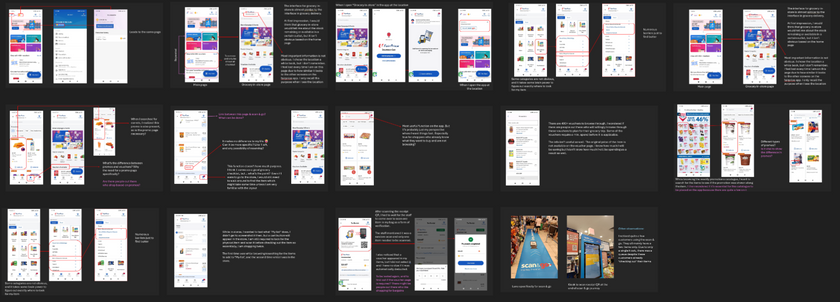
Here’s a summary of my analysis, for a better view:
Key insights I discovered during the analysis:
#1: Integration with Kopitiam - Kopitiam is part of the FairPrice Group, offering an opportunity for integrated services across different business areas.
#2: Cashless Experience with Pay/Earn - The Pay/Earn feature was designed to support a cashless, cardless experience, enabling users to earn LinkPoints while shopping at FairPrice Group outlets. This also explains the inclusion of Food Takeaway options.
#3: Consolidation of Grocery Delivery and In-Store Shopping - The features for grocery delivery and in-store shopping are nearly identical; merging them could streamline the user experience.
#4: Promotion Redundancies - Items in special campaigns are also marked as promos in the general list. This raises the question of whether it’s necessary to separate them by campaign.
#5: Limited Stock Information - The "Grocery In-Store" feature only indicates "Low in stock," which isn't very actionable for users, as there's no way to reserve items. This limitation could lead to frustration as users repeatedly check item availability.
These insights highlight key areas to consider as I work on enhancing the app experience.
AT THE END OF PROBLEM DISCOVERY
Having completed extensive research, I’m now ready to focus on enhancing the application. To provide clarity, here is a consolidated list of areas for improvement that I plan to address:
#1: Improving the user experience
- Reducing the friction on using the app by keeping everything easy.
#2: Reducing the noise from campaigns.
- Discounts are already applied on the product, so does it matter to users which campaigns it is from?
- Consolidating the different ways to shop for groceries (Online/In-stores, the flow is the same, items available online may not be present in stores)
- Eliminate the need to hunt for vouchers
#3: Streamlining the branding to send a clearer message to users
- Making it more obvious that LinkPoint is the glue for this app
- Making it clearer the different ways FairPrice is making “Everything Food made Easy” for users. E.g. Either buying groceries for cooking or taking away food will allow users to earn points and save with FairPrice
#4: Helping young adults on their journey by
- Simplifying the grocery buying experience by allowing them to create a grocery list immediately to cart
WORKING ON VISUAL ENHANCEMENT
My first priority is to improve the FairPrice app’s color choices, which currently feel loud and disorganized, clashing with the tagline, 'Everything Food Made Easy.' The existing vibrant red and blue symbolize NTUC unity and professionalism, but the bold tones can overwhelm the user experience. I opted for a softer blue within the same palette to convey trustworthiness and a cohesive, welcoming feel that better aligns with FairPrice's mission and humble approach.

.jpg)
I also refined the card design, which initially felt oversized and overloaded with information. This redesign allowed me to simplify the layout while practicing and honing my UI skills, creating a more streamlined and user-friendly experience.
Comparison of the homepage before and after redesign:
#1: Increased Visibility for LinkPoints and Pay/Earn: These features were enhanced to serve as the central 'glue' connecting all functions.
#2: Consolidated Grocery In-Store and Delivery Options: Streamlined the shopping experience by merging similar grocery features.
#3: Distinct Pathways for Food Solutions: Clarified FairPrice’s different approaches to 'making everything food easy,' providing clearer access to dining, takeaway, and grocery options.

.jpg)
This is the customer journey: Users start by selecting groceries, with access to a recipe page where they can browse cooking ideas. Once they find a recipe they like, they can easily add the ingredients to their shopping list. From there, they have the flexibility to check out the items in-store or online directly from their list.
.jpg)
.jpg)
This enhanced grocery purchase experience, powered by AI, addresses users who may not have the time or desire to decide what to cook. The AI filters options based on time constraints and preferences, offering tailored recipe recommendations for users to select without needing to browse the full recipe page.
Putting it all together, here's the complete flow:
.jpg)
USABILITY TESTING
I tested the flow outlined above using the test script provided below with users.
Task 1: Finding a Recipe
"Imagine that you’re looking for a new recipe to try for dinner tonight. Use the app to find a recipe that interests you."
Questions:
- "How easy or difficult was it to find a recipe?"
- "What did you like or dislike about the recipe search process?"
- "Was the information provided about the recipe clear and helpful?"
- “[if users used the recipe recommendation option} Did you enjoy using the recipe recommendation option?
- “Could you tell the various features available for the recipe?”
- “Do you know how to save recipe for later when you are ready to cook?”
Task 2: Adding Ingredients to a Shopping List
"Now that you’ve selected a recipe, add the ingredients to your shopping list using the app.")
Questions:
- "Was the process of adding ingredients to your shopping list intuitive?"
- "Did you encounter any issues while doing this?"
- "How useful did you find the shopping list feature?"
Task 3: Modifying the Shopping List
"You realize that you already have some of the ingredients at home. Please remove those ingredients from your shopping list."
Questions:
- "How easy or difficult was it to remove items from the shopping list?"
- "Were there any features you would have liked to have during this process?"
Task 4: Checking Out
"Assume you’ve completed your shopping. Go through the checkout process to review your shopping list and confirm your purchase."
Questions:
- "How straightforward was the checkout process?"
- "Were there any steps that confused or frustrated you?"
- "Was there anything you wished was different in the checkout process?"
- “was it easy for you to know how to checkout online or in store?” Could you tell the difference?
Below is a consolidation of their feedback, along with the improvements I made based on their comments.
.jpg)
.jpg)
.jpg)
ENHANCEMENT AFTER USABILITY TESTING
After incorporating user feedback and reconsidering key design choices, such as the representation of the AI feature, I developed this finalized flow. Below is a summary of the goals I aim to achieve with these enhancements.
Designing an appropriate representation for the AI was challenging, requiring multiple iterations to find one that matched the app’s style. I wanted to avoid using a cute chatbot icon, as the AI doesn’t function as a chatbot, but I still aimed to give it an approachable, friendly appearance.
At last, here’s the finalized flow!
.jpg)
.jpg)
.jpg)
.jpg)
.jpg)
REFLECTIONS
1. I realized there was an opportunity to go further by developing a more detailed sequence, such as designing the full checkout flow, including the look and feel of the payment pages.
2. I feel my UI skills have improved through this project, and I’m pleased with the enhancements I achieved here. I’m eager to keep refining my skills and building confidence in UI design across future projects.
3. In enhancing the FairPrice app, I realized that improving the visibility of features like LinkPoints and Pay/Earn wasn’t just about functionality—it subtly contributed to the brand experience as well. By centralizing these features, I hoped to create a more cohesive and rewarding journey that would reflect FairPrice’s customer-focused values. This project gave me valuable insight into how thoughtful design can help strengthen a brand’s identity, and it’s been a meaningful learning experience in understanding the connection between usability and brand perception.


Thanks for reading! Feel free to drop me a comment


Jump back to the homepage


Or view my other works!

A personalized recipe app tailored to your schedule and available ingredients
.jpg)
An app designed to help households and businesses reduce food waste
"My first UX/UI case study"