Launching Keewa’s Digital-First Experience in Singapore
Redefining Custom Footwear for a New Market:
Product Management with UX/UI coursework, conducted at MAGES Institute in collaboration with Creativeans.
"How might we design a localized, scalable 100% digital platform for Keewa that makes customized leather footwear desirable, intuitive, and accessible to Gen Z and Y consumers in Singapore—while staying true to its roots in sustainability and traditional craftsmanship?"
🔍 Background & Business Goal
Keewa is an Indonesian brand known for its handcrafted leather footwear and commitment to sustainability. With ambitions to expand globally, Keewa aimed to enter the Singapore market through a 100% digital platform that allows customers to design and order custom footwear. My role was to define the product strategy that would drive a successful market entry—by aligning brand values with local customer behavior and digital UX—and to design a digital platform that could bring this strategy to life.
🌍 Business Objectives:
-
Launch in Singapore with a digital-first experience.
-
Increase brand awareness among Gen Z & Y consumers (ages 12–40).
-
Stay true to Keewa’s commitment to craftsmanship and sustainability.
-
Position Keewa as affordable luxury and customization-first.
🧠 Discovery & Market Research
I began by conducting market research, competitor benchmarking, and qualitative user interviews to understand the local market dynamics, user behaviors, and gaps in current offerings.
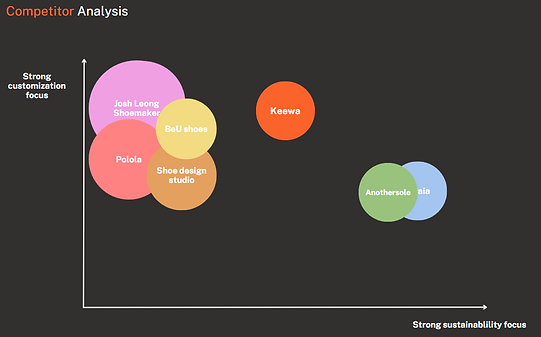
📊 Competitor Landscape
-
Customization-first: Polola, BeU Shoes, Josh Leong Shoemaker
-
Sustainability-first: Anothersole, Vivaia
🔍 Key Market Insights
-
Keewa’s direct competitors are Anothersole and Vivaia.
-
Bright, bold colors (especially for women) sell well in Singapore.
-
Leather is often seen as expensive, luxurious, and high-maintenance.
-
Sneakers and sandals dominate day-to-day wear.
-
Customization is desirable, but most users lack confidence in styling.
🛠️ Improvement Areas Identified
-
Expand catalogue options to cater more to female audiences, especially with bold colorways and styles.
-
Strengthen sustainability messaging across Keewa’s digital platform:
-
Where is the leather sourced from?
-
Is it ethically produced?
-
Is the production process sustainable?
-
What is the brand giving back for each pair sold?
-
🌱 What I Discovered
Keewa will need to clearly define its sustainability goals, especially since direct competitors like Anothersole and Vivaia are already prioritizing sustainability efforts. It’s not enough to mention material origins—Keewa must align its sustainability messaging with authentic brand values and demonstrate real environmental and social responsibility.
🧩 User Research & Insights
🚀 Opportunities for Keewa’s Product Strategy
What I gathered from my observations, user interviews, surveys, and brand perception checks across Singapore.
1. Redefine Leather for Singapore’s Lifestyle
Address the perception that leather shoes are expensive, high-maintenance, and too formal.
→ Explore introducing water-resistant leather and emphasize easy-care features to position leather as both stylish and practical.
How might Keewa democratize luxury for the everyday Singaporeans?
2. Sneaker-Inspired Comfort & Versatility
Most locals opt for sneakers or casual footwear in daily life.
→ Expand designs that reflect sneaker aesthetics while staying true to Keewa’s identity — striking a balance between comfort and craftsmanship.
3. Lower the Barrier to Customization
While many users are excited by the idea of customization, they often feel unsure where to begin.
→ Provide design templates, guided flows, or visual inspiration to make customizing feel less intimidating and more approachable.
How might Keewa help customers confidently co-create their perfect pair?
✨ You can explore the supporting research insights in more detail below.
👟 Shoes of Singapore: A Street-Level Perspective
Understanding Local Preferences in Footwear to Inform Product Fit and Style Strategy
I conducted informal observational research around various neighborhoods and public transport hubs in Singapore to see what types of shoes people typically wear in their daily lives. The majority of Singaporeans opt for casual and comfortable footwear – primarily sneakers and crocs/sandals. These choices are likely influenced by Singapore’s hot and humid weather, the practical need for comfort, and a generally casual dress culture in daily life.
Insight:
👟 Most Singaporeans prioritize comfort and practicality in their footwear, with sneakers and sandals dominating everyday wear.
Implications for Keewa’s Product Strategy:
-
Product Design: Introduce leather sneakers and slip-ons to align with local comfort trends while maintaining brand identity.
-
Materials: Use lightweight, breathable, or water-resistant leather to cater to the climate and lifestyle.
-
Messaging: Emphasize everyday wearability and comfort-first luxury in marketing to local users.
-
Customization Ideas: Allow users to customize sneaker silhouettes or hybrid casual-formal styles.
🧠 Perception Check: What Do People Think About Keewa Shoes?
After identifying common footwear trends in Singapore, I showed Keewa’s product catalogue to several individuals and asked for their first impressions. The goal was to understand how Singaporean consumers perceive the brand in terms of practicality, design, and relevance to their daily needs.
What I Asked:
-
“Would you wear this?”
-
“What stands out to you about this shoe?”
-
“Does this fit your lifestyle?”
-
“What do you think this brand is trying to say?”
Insight:
👫 Males were more focused on practicality and function, commenting on whether the shoes would serve them well in daily life.
👠 Females were more drawn to the design and aesthetic, often asking about available colors, heel height, and visual appeal.
Implications for Keewa’s Product Strategy:
-
Product Offering: Consider gender-inclusive variations — emphasizing utility-focused features for male consumers, and expanded design customizations for female consumers.
-
User Segmentation: Create differentiated user journeys within the digital platform:
-
Function-first path (e.g. durable soles, water-resistant options, daily-wear focus)
-
Style-first path (e.g. color combos, material selection, statement design templates)
-
-
Marketing Messaging:
-
For men: Highlight comfort, utility, weather-appropriateness
-
For women: Spotlight uniqueness, expression, and elegance of form
-
🔍 From Conversations to Clarity
Uncovering user motivations and pain points through in-depth interviews and surveys.
💡 Key Insights from Interviews & Surveys
-
Most people own different shoes for different occasions — only a few try to make one pair do it all.
-
Leather shoes are perceived as high-maintenance, costly, and luxurious — customization adds to that perceived cost.
-
There is openness to customization — if it’s intuitive and available.
-
Comfort is the number one priority, followed by style and design.
-
Bright colors are popular, especially among women.
-
Sneaker styles are the preferred choice for everyday wear.
🔍 As-Is Customer Journey Map
Understanding the Current Experience with Keewa
This map outlines how users currently interact with Keewa’s platform, highlighting key pain points, gaps, and opportunities for improvement.
🧭 Insights from the As-Is Customer Journey Mapping
Insight #1:Keewa’s customization options are not clearly communicated. The online catalog feels like a selection of ready-made shoes rather than a customizable experience. This may cause customers to overlook the brand’s core offering of style personalization.
Insight #2: Keewa could enhance creative inspiration by integrating more photos from their Instagram onto the website. This could help users visualize possibilities and feel more confident about customizing their own designs.
Insight #3: The integration of WhatsApp on the website is a smart move — it allows direct customer communication, which builds trust and offers Keewa an opportunity to provide real-time support and assurance. This feature is worth retaining and possibly expanding on the future digital platform.
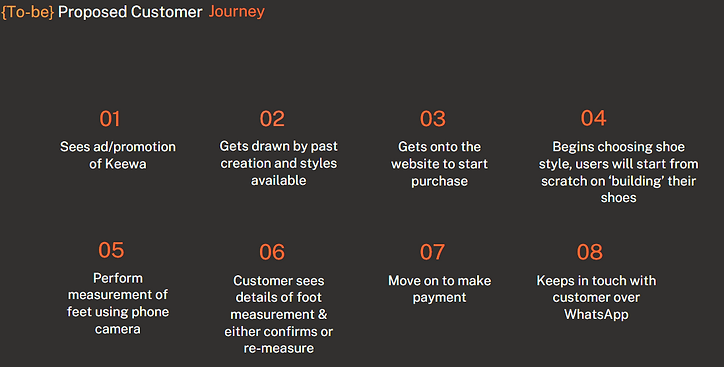
🚀 To-Be Customer Journey Map
Envisioning the Ideal Experience through Strategic Improvements
Based on the examination of the As-Is customer journey mapping and insights gathered from user research, this To-Be customer journey map outlines the future state of the customer experience. It reflects proposed product strategies and design enhancements aimed at improving the user experience and supporting business goals.
Based on the proposed to-be customer journey mapping, I identified that the best digital platform for Keewa would be a mobile-optimized website, as most customers are expected to arrive via social media (typically accessed on mobile), and the foot measurement process would require camera access.
🎯 Product Strategy
I translated these insights into a four-pillar product strategy focused on differentiation, customer empowerment, and business scalability:
1. Product Expansion & Market Fit
-
Add sneaker-style shoes & water-resistant leather options.
-
Expand catalogue to cater to more female-forward designs.
-
Introduce style tiers (bold → minimal) to widen appeal.
2. Positioning & Messaging
-
Reframe leather as “everyday luxury” and show how Keewa democratizes customization.
-
Highlight sustainability practices transparently (material source, ethical production, give-back initiatives).
-
Explain “why leather” and “why made-to-order.”
3. Seamless Customization Experience
-
Introduce onboarding, creative prompts, and pre-made templates.
-
Offer live previews, color suggestions, and undo options.
-
Provide guidance for users who don’t know how to start.
4. Trust & Transparency
-
Build reassurance with fit guides, measurement validation, and local support.
-
Showcase reviews, social proof, and behind-the-scenes stories.
-
Highlight return policy clearly—especially for overseas orders.
📊 Success Metrics
To measure the success of Keewa’s digital platform and product strategy, we can track the following key performance indicators (KPIs):
🗺 Product Roadmap (Key Initiatives)
The product roadmap serves as a strategic blueprint for the development and execution of Keewa’s digital platform. Each phase of the roadmap is aligned with both short-term user needs and long-term strategic objectives, ensuring that the product not only meets market demands but also establishes a solid foundation for future growth.
🧪 User Stories & Acceptance Criteria
I defined key user stories for customization and measurement, with measurable acceptance criteria for each. You may click through the slide deck gallery to find out more.
✨ Digital Experience Prototype
Translating Strategy into Interface: The New Keewa Customization Platform
🔍 Conducted Usability Testing to Validate Early Concepts
User feedback revealed several key areas for refinement:
-
Unclear scanning steps → Refined instructions for the foot measurement process, including visual cues and guiding lines to ensure proper angle and fit.
-
Pricing curiosity during customization → Introduced a persistent cost summary to maintain transparency throughout the design process.
-
Desire for guidance on sole/material selection → Added AI-generated prompts and educational tooltips for informed decision-making.
-
Brand identity not obvious → Users didn’t immediately recognize Keewa as a customizable leather shoe brand. Adjustments were made to highlight the brand's unique value proposition earlier in the journey.
-
Lack of return policy visibility → Made return and exchange policies more prominent within the platform for reassurance.
-
Confusion around batik artwork → Clarified how the cultural element of batik ties back to the brand story and product identity.
-
Customization flow unclear → Users were unsure about options:
-
Indicate customization options upfront before prompting for color selection.
-
Use of a blank slate shoe model and possibly a 3D visualization tool to better support creativity and personalization.
-
Color selection felt more like a step in a linear flow rather than one of two mutually exclusive design paths—this was restructured for clarity.
-
📈 Outcome & Next Steps
This product strategy helped reframe Keewa from a traditional leather brand to a modern, customization-first digital player. It also laid the groundwork for a successful market entry in Singapore with the potential for global scalability.
Next phases would include:
-
Building MVP to test customization experience
-
A/B testing messaging around leather perception
-
Piloting a local fulfillment or return partner to reduce friction
✍️ Final Reflection
This case taught me how product strategy can bridge brand heritage with market-specific behaviors. By embedding UX, research, and business thinking, I was able to turn a culturally rich product into an experience that resonates with a new generation of digital-first consumers.
Crafting a well-designed user survey is harder than it looks—I realized this was largely due to a lack of clarity in the direction I wanted to take for the project. I could have gone deeper into researching how users actually perceive and approach buying shoes, especially in a customization context.
Another key learning was the importance of paying close attention to the product itself. I overlooked small details, like the presence of laces, and missed the opportunity to design around them—such as how users might want to choose lace color or type. This reminded me that good design is not just about user needs, but also about intimately understanding the product you're designing for.
I also became aware of my own tendency to design from a scarcity mindset—constantly trying to add more in hopes of standing out. But I’ve learned that sometimes, less truly is more. Just focusing on perfecting the core customization experience is already a powerful and meaningful step forward for Keewa.